
American Medical Research Saves Lives
OMB Proposed Rule
In late May, the Office of Management and Budget (OMB) issued a proposed rule that would significantly change how grants and cooperative agreements are awarded, managed, and terminated across the federal government. OMB set an Oct. 1 date for finalizing the proposed rule.
This proposal would weaken the role of expert scientific review in funding decisions while:
Elevating political review
Expanding agencies’ authority to suspend or terminate clinical trials and other research without any right to appeal
Allowing grant requirements to be changed midstream
Jeopardizing health disparities research
Disincentivizing research collaborations and scientific exchange
Imposing significant new bureaucratic requirements that slow, add costs to, and reduce the volume of research conducted in the U.S.
Taken together, these changes would move the federal research funding system away from scientific merit, collaboration, and stability. The result would be slower scientific and medical progress, delaying the discoveries, treatments, cures, and public health advances that Americans depend on.

American Voices on Medical Research
Real stories from families, patients, and researchers whose lives are touched by NIH-funded medical research. These voices show why continued investment in science matters.
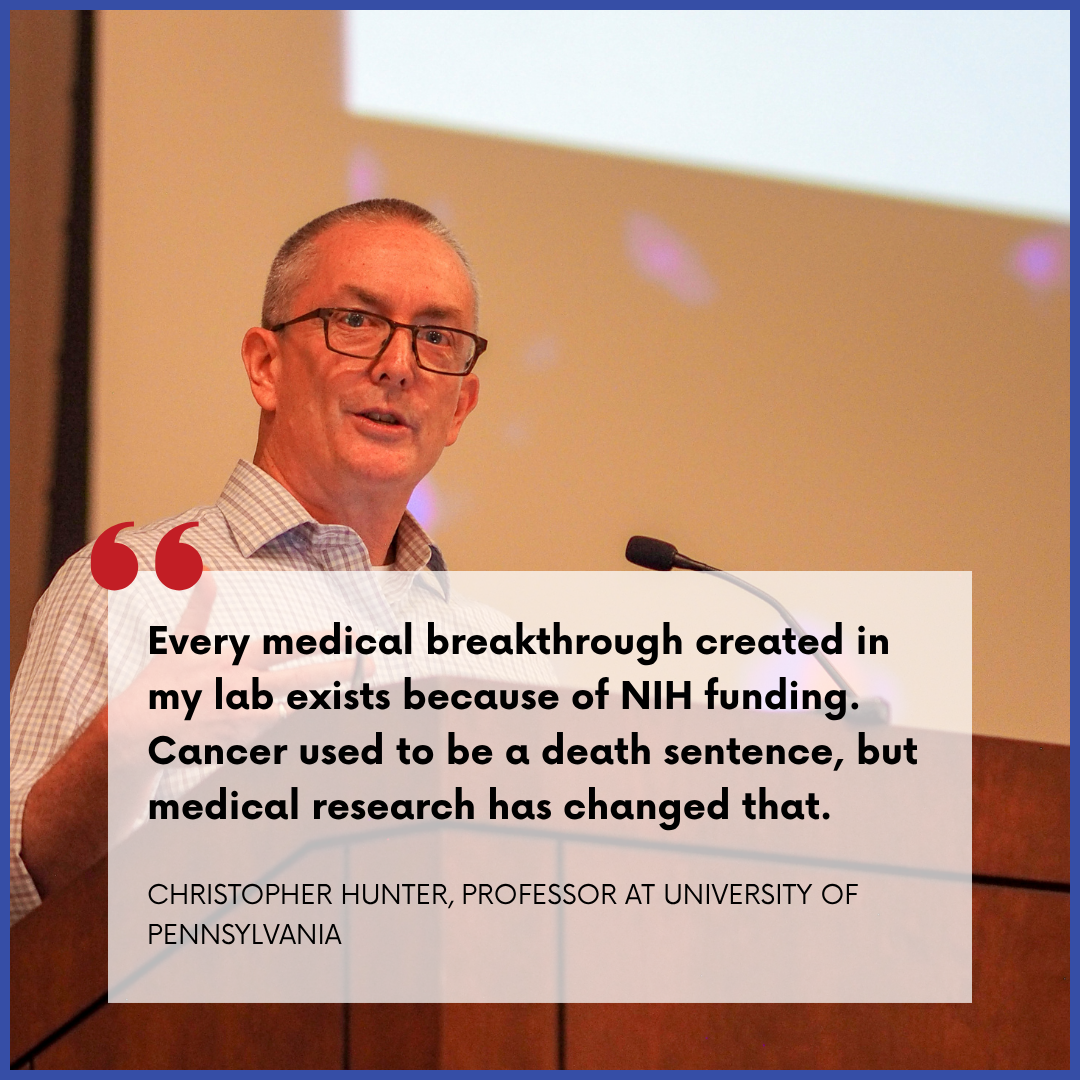
Over the last century, NIH-funded research has helped improve the early detection and treatment of serious diseases. This research has helped doctors better identify variations in breast cancer and provided them with numerous early detection tools. These innovations have led to a 58% decrease in the breast cancer death rate and improved the quality of life for people living with heart disease, diabetes, arthritis, and more.
Americans Depend on NIH-Funded Research

Keep Up the Progress
Kids with cancer, seniors with Alzheimer’s and families looking for answers are counting on NIH-funded clinical trials and research. Each year, thousands of children join NIH-backed cancer trials, and more than 230 Alzheimer’s trials are underway with treatments now able to help slow the disease in its early stages. We’re closer than ever to breakthroughs that could help millions of Americans.

Heart Disease: prevention strategies have led to a 67.6% decrease in deaths.
Opioid Use Disorder: the development of a drug to treat the disorder has reduced the risk of dying from successive overdoses by 38%.
Breast Cancer: the five-year survival rate for breast cancer has risen from 75% to 99% when caught early.
Childhood Cancer: the development of chemotherapy has increased childhood cancer survival rates from 5% to 85%.
Thanks to NIH research, groundbreaking treatments and therapies have prolonged people’s lives and dramatically improved their quality of life.
Imagine What’s Possible with Investments in Scientific Research
Imagine what could be possible if we continue to invest in medical research and make even more progress on the diseases that impact American families every day.



Supporters

























News
-
Jessica Blake | 8.4.26
A controversial rule that would give the Trump administration more control over grants won’t take effect until mid-December—at least—under a Senate plan to temporarily fund the government.
The Senate plan, released Sunday, would prevent the government from shutting down after Sept. 30 when the fiscal year ends. Higher education research advocates praised the delay in the Office of Management and Budget’s (OMB) proposed changes to the federal grant rules. Thousands of critics in and outside higher ed opposed the rule in public comments, saying it could undercut research and all the societal benefits that flow from it.
-
Paul M. Krawzak | 7.20.26
Opposition is building to a sweeping government-wide crackdown on federal grant awards, with opponents threatening litigation over a proposed rule that would put the grant approval process into the hands of political appointees.
A request for public comment on the rule by the Office of Management and Budget triggered almost half a million responses, most of them opposed to the changes.
-
Harold Collard, M.D. | 7.10.26
The OMB’s proposed revisions are the most recent manifestation of a longstanding national debate regarding the proper framework for American scientific stewardship. Two of OMB’s proposals—the addition of a political review to individual funding decisions for research awards and the allowance of award terminations of currently funded federal research for political reasons—are, in many ways, a science policy redux. Understanding their historical and political context is important to identifying successful solutions.
-
Ryan Quinn | 7.7.26
The White House in late May proposed a rule that would cement its control over essentially all federal grant making, including research funding and Education Department grants.
Among other changes, the proposal from the Office of Management and Budget says political appointees, not peer reviewers, would be the primary deciders of who gets grants, and says officials could yank funding even after it’s awarded and research or another project has begun.
-
Brent Donelan | 12.10.25
My son, Patrick, wanted to go to culinary school to learn to be a chef.
But at the age of 10, he was diagnosed with retinitis pigmentosa, an inherited disease of the retina. Within a decade, he was blind. He had to abandon his career goals and learn to navigate the world in a different way
-
Suzanne King | 12.10.25
Dr. Jason Stubbs, a nephrologist at the University of Kansas Medical Center, is on the brink of the biggest breakthrough of his career.
Through studies on mice over the last decade, he has shown that damage to an important part of the kidney’s filtration system can be slowed when dietary phosphate is limited.
-
Jon Nelson | 11.20.25
The federal government saved my life.
That is no overstatement. For 10 excruciating years, beginning in my mid-30s, I tried every possible medication and treatment to relieve the deep-seated depression that made me want to die every second of every day. Nothing worked.
-
Allyson Chiu | 11.17.25
Amy Nunn and Philip Chan had just started to enroll participants in a federally funded clinical trial for HIV prevention when their work came to an abrupt halt in early March.
“I panicked,” said Nunn, CEO of the nonprofit Rhode Island Public Health Institute, whose research was focused on Black and Hispanic men and their use of the preventive medication for HIV known as pre-exposure prophylaxis, or PrEP. “I was worried we might lose everything.”
-
Chris Sciamanna | 11.16.25
When older adults lose their ability to walk, it’s a drain on their lives. It’s also a drain on taxpayers.
That’s because Medicaid, the joint federal-state health care program for people with low incomes, pays the lion’s share of the bill for nearly two-thirds of nursing home residents nationwide. And lack of mobility — being unable to walk or climb stairs — is one reason many people move into nursing homes.